 UZBEKISTAN TEXTILE AND GARMENT


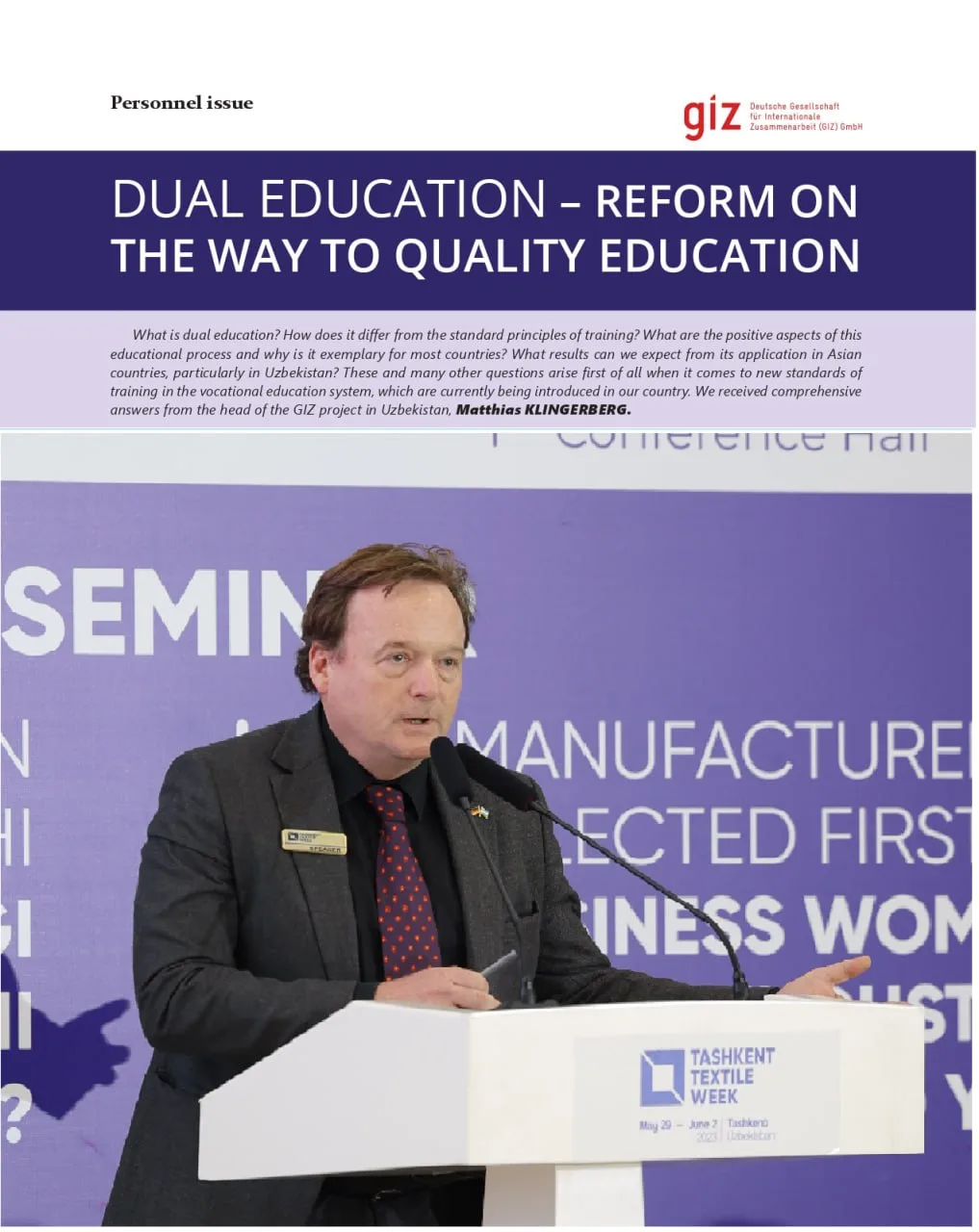
What is dual education? How does it differ from the standard principles of training? What are the positive aspects of this educational process and why is it exemplary for most countries? What results can we expect from its application in Asian countries, particularly in Uzbekistan? These and many other questions arise first of all when it comes to new standards of training in the vocational education system, which are currently being introduced in our country. We received comprehensive answers from the head of the GIZ project in Uzbekistan, Matthias KLINGERBERG.
– Germany is considered to be the originator of the dual education system. Currently, the experience of this country serves as a model not only for the European Union but also for other countries. Tell us more about the German dual education system. What are the differences?
– The German Dual Education system, also known as the dual vocational training system, is unique and differs from other countries’ education systems in several ways. Here are some key differences:
The dual system is the central element of the German Vocational Education system, is called “dual” because training takes place at two learning venues; in the company and at the vocational school. Depending on the occupation, duration of training is between two and three and a half years. Upon passing the final examination, apprentices receive a chamber certificate to document that training has been successfully completed. This certifies that they are in possession of employability skills in one of the state- recognized occupations.
One of the main success factors is the collaboration between Educational Institutions and Businesses: Close collaboration and partnerships between vocational schools and private companies play a crucial role in the dual system. Companies actively participate in the training process, providing training facilities, mentorship, and job opportunities for students.
– It is well known that before introducing something new, both positive and negative sides of the innovation are thoroughly studied. What are the pros and cons of the new education system? Why is it believed that the reform of the education system through the introduction of dual educational process will lead to an increase in the quality of education in general?
– The Dual Education system is often believed to lead to an increase in the quality of education for several reasons:
- Practical Skills Development: The dual educational process places a strong emphasis on practical skills development. This ensures that graduates are better prepared and equipped to meet the demands of the job market.
- Industry Relevance: The involvement of businesses and industry in the dual system ensures that the curriculum remains relevant to the needs of the labor market.
- Close Collaboration: Dual education fosters close collaboration between educational institutions and businesses. This collaboration allows for continuous feedback and communication between the two.
- Smooth Transition to the Workforce: The integration of workbased learning in the dual system facilitates a smoother transition from education to employment.
It is essential to recognize that while the dual education system has numerous advantages, it also its drawbacks, some are mentioned below:
- Early specialization: Students in the dual education system usually choose their career paths early on, often at the age of 15 or 16. While this early specialization can be beneficial for those who have a clear career goal, it may lead to a lack of flexibility for those who want to change their career trajectory later in life.
- Limited options for academic advancement: While the dual education system provides a strong foundation for vocational careers, it may not offer as many opportunities for academic advancement, such as pursuing a university degree.
- Industry-specific training: The training received in the dual education system is highly tailored to specific industries and job roles. While this is beneficial for companies seeking skilled workers, it might not equip students with the versatility to adapt to changing job market demands or shifts in the economy.
- Stigma around vocational education: In some societies, there might be a social stigma attached to vocational education, where academic paths are seen as more prestigious or desirable.
– How does dual education develop in other countries? Please give real examples of the positive impact of this system on the quality of education. What foreign countries’ experience has been studied and applied in our country? What types of dual education are being implemented in Uzbekistan?
– As we noted earlier, dual training, first of all, makes it possible for enterprises to train personnel “on order”, ensuring their maximum compliance with their requirements. Thus, enterprises can save on the search and selection of workers, their retraining and adaptation. In turn, students from the first year receive a specific place for practical training, as well as a clear understanding of what and why they are studying in an educational institution.
Many countries apply this experience. Today, the German model is used in Greece, Italy, Spain, China, Sweden, Romania, South Korea, as well as African countries. However, all these states are adapting the system, taking into account the peculiarities of their economy.
In Uzbekistan the European dual education approach is studied, especially those approaches in particular, which were very successful in their countries. To do this, GIZ projects in this area use various approaches: from attracting European experts to bring expertise to the Uzbek reality, to organizing study and training visits of local stakeholders to Germany, to visit various institutions that provide an effective process of dual learning.
In Uzbekistan, two institutions are advising its national implementation partners regarding TVET standards from German-speaking countries:
- GIZ is implementing two projects on behalf of the German Federal Ministry for Economic Cooperation and Development (BMZ): “Support of the reform and modernization process in the vocational education system of Uzbekistan (TexVET)” with a project duration until September 2025 and “Professional Education for Economic Growth Sectors in Central Asia (PECA V)” running until May 2024.
- Furthermore, on UN level TVET advice is currently delivered by the UNESCO project “Skills Development for Employability in Rural Areas of Uzbekistan” funded by the European Union.
- The German government through its Federal institute for Dual Education, BIBB, and the embedded German Office for International Cooperation in Vocational Education and Training (GOVET) are aiming to promote and strengthen TVET worldwide.
There are many success stories of implementing the German dual education system. The successful cooperation shows itself e. g. through the organization of study trips, knowledge exchange and policy advice which led to the establishment of a national TVET strategy in some of the countries.
The implementation of the dual education project will help textile enterprises develop through the exchange of experience and familiarization with the best European and domestic developments in the field of vocational education and the development of the competencies of industry specialists.
– Which professional educational institutions in the textile industry are already really working on the system of dual education and can we talk about its effectiveness after a year?
– Together with textile companies was organized the implementation dual education in the 15 vocational schools throughout Uzbekistan, where they study textile professions such as Khodjeli vocational school, Kurgantepe vocational school No. 1, Vocational school No. 2 of Margilan, Khiva service college, Vocational school No. 2 of the Jambay region and others.
– With what enterprises and organizations are agreements/ contracts of vocational educational institutions in the field of textile industry concluded? Tell us more about the mechanism of partnership relations in the system of dual education.
– The dual education system in Germany relies on a series of partnerships:
- at the macro level, the enterprise, company employees and the state share the costs and benefits that can be obtained from investing in vocational training
at the meso level of regions, industry associations and trade unions, state functions are transferred to chambers of commerce and industry and business associations to control the quality of secondary vocational education.
- at the micro level, dual training ensures that firms coordinate with education authorities on professional standards and related training.
In Uzbekistan, there are successful examples of partnerships between business companies and professional educational institutions in order to train personnel in the dual education format. According to representatives of enterprises, this system improves the efficiency of work organization and increases the competence and professionalism of students. Such companies include Industry Enterprises of Namangan region (“TEKSTIL LIBOS”, “ART SOFT TEXTILE”, “Namangan tukimachi”), Andijan region (“HANTEX”, “NIL GRANIT”, “MILANA TEXTILE”), Fergana region (“INDORAMA KOKAND TEXTILE” and others.
- Of course, it may be too early to talk about any clear advantages of dual education, it will take a lot of time to be convinced of its effectiveness. What is your vision of the education system of Uzbekistan on the rails of dual education?
- What is traditional education inferior to dual, let’s try to figure it out:
The main problem of traditional education is the low competitiveness of graduates, the discrepancy between the results of education and the requirements of employers, graduates of institutions experience difficulties with employment, therefore, a new mechanism of interaction with employers is needed, which allows: functions, determine the necessary additional competencies, form these competencies taking into account the labor market.
The dual system meets the interests of all parties involved in it – enterprises, workers, the state. For an enterprise, this is an opportunity to train personnel exactly “to order”, ensuring their maximum compliance with all their requirements, saving on the costs of finding and selecting employees, retraining and adapting them. For young people, dual education is a great chance to acquire independence early and adapt to adult life more easily. The level of education within its framework is constantly increasing. In turn, this approach motivates students to learn not just for show.
To sum up, the dual system of education makes it possible to train personnel who, upon leaving the educational institution, not only have a diploma of a specialist in a particular field but can independently solve any professional tasks. Moreover, taking into account the specifics of the organization or enterprise where they underwent dual training. The value of such specialists for production cannot be compared with ordinary graduates, and it is they who are relied upon as candidates for the personnel reserve, from which middle and senior managers grow.